How to Choose Your First Surf Lesson
Everyone gets to the shoreline with the same question: where do I start?
There are so many schools, so many types of lessons, and so much conflicting information online that a lot of people end up putting off the decision — or making the wrong choice first time.
And the truth is, the right choice makes a huge difference. Not just in the first session, but in everything that comes after: the confidence you build, the safety you feel, and the desire to come back.
In this guide, we’ll explain exactly what you need to consider before booking your first surf lesson — without overcomplicating it.
1. Make Sure the Surf School Is Certified
This is the starting point. And a lot of people ignore it.
In Portugal, all surf schools that operate legally must be registered with the Portuguese Surfing Federation (FPS) and licensed by Turismo de Portugal.
Why does this matter? Because it ensures that:
- Instructors have certified training
- Lessons follow defined safety standards
- Equipment meets minimum requirements
- You’re covered in case of an accident
If the school isn’t registered with the FPS, there are no guarantees. Before you book, always check that the certificate is visible on the website — or ask directly.
At Gecko Surf School, all lessons are certified by the FPS and Turismo de Portugal. You can check here:
https://www.surfingportugal.com/lista-de-escolas-registadas-na-fps/
2. Understand Which Type of Surf Lesson Is Right for You
This is the decision most people struggle with. There are three main types of lessons:
Group Surf Lessons
They’re the most common and the most affordable. You learn with other beginners in a relaxed, motivating environment. There’s healthy competition, shared experiences, and great vibes.
Ideal for: anyone who wants to try it out, socialise, or has a tighter budget.
Private Surf Lessons
You have the instructor just for you throughout the whole session. Feedback is constant, technique corrections are immediate, and progress is usually faster. It’s the best option if you really want to learn quickly or if you’re a bit nervous about the sea.
Ideal for: anyone who wants fast progress, prefers a calmer setting, or is recovering from an injury.
Semi-Private Surf Lessons
The middle ground. It works for two surfers — usually a couple, two friends, or a parent and child. You get almost one-to-one attention from the instructor, with the comfort of not being alone.
Ideal for: pairs who want to learn together with more attention than in a group lesson.
There’s no single right answer for everyone. It depends on your profile, your pace, and what you want from the experience.
3. Check What’s Included in the Surf Lesson
It seems obvious, but a lot of people only realise on the day. In a first surf lesson, equipment should always be included:
- Surfboard (softboard, ideal for beginners)
- Wetsuit (essential in Portugal, even in summer)
- Personal accident insurance
If the school doesn’t include any of these, you need to factor in the real cost of the lesson.
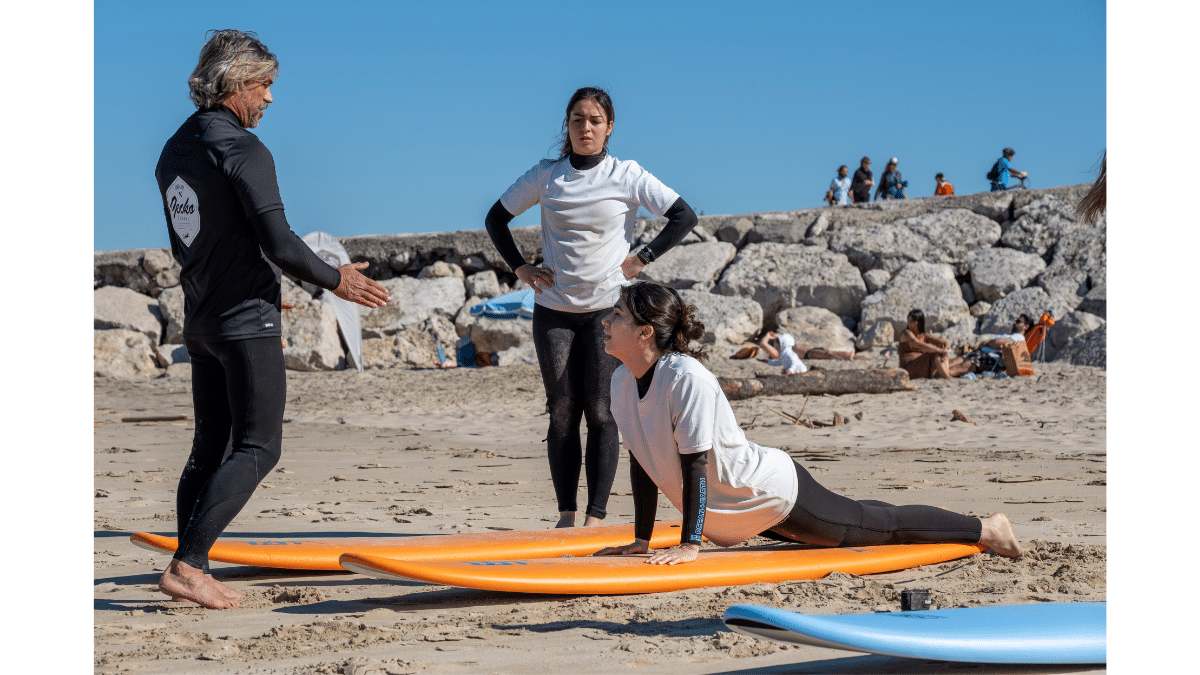
Beyond equipment, a good beginner surf lesson should cover:
- An introduction to ocean safety
- Basic knowledge of the equipment
- Paddling technique
- How to do the pop-up correctly
- How to control the board on the wave
4. Choose the Right Beach for Your Surf Lesson
It matters. Some beaches are more suitable for beginners than others. Ideally, you want a beach with:
- Small, consistent waves
- No strong currents
- A sandy bottom
- Good visibility for the instructor
Costa da Caparica is one of the best places to learn to surf in Portugal for exactly these reasons. It has consistent waves along kilometres of beach, a sandy bottom, and conditions that work well for all levels.
That’s why Gecko Surf School has been here for years — and it’s still one of the most popular choices for anyone looking for their first surf lesson near Lisbon:
5. Don’t Choose a School Just Because of a Pretty Photo on Social Media
Social media is a good window — but a small one. Before you book, it’s worth digging a little deeper:
- Read Google reviews (quantity and quality)
- Check whether the school replies to comments (it shows they care)
- Look for opinions in surf forums or groups
- Confirm how long the school has been operating
A school with years of activity and consistently positive reviews says far more than a well-curated Instagram feed.
6. Talk to the Surf School Before You Book
It may seem like an unnecessary step, but it makes all the difference — especially if you’re a bit nervous about the sea, if you’re not a strong swimmer, or if you have any physical limitations.
A good school answers your questions before taking your money. Look out for:
- Response time (serious schools reply quickly)
- Willingness to adapt the lesson to your level
- Clear safety information
If you feel the school is more focused on closing the sale than understanding your profile, that’s a bad sign.
7. Ask What the Maximum Number of Students per Instructor Is
In group lessons, the number of students per instructor matters a lot. A class that’s too big means:
- Less attention per person
- Fewer technique corrections
- More waiting time and less time in the water
Ideally, each instructor should have no more than 5 to 6 students in a beginner lesson. Ask beforehand — it’s a detail that makes a real difference to your experience.
What to Bring to Your First Surf Lesson
Now that you know how to choose, here’s a quick list of what you should bring:
- Swimwear or comfortable underwear (you’ll wear the wetsuit over it)
- Water-resistant sunscreen
- A towel and dry clothes for afterwards
- Water to stay hydrated
- An action camera — if you want to capture the moment
Conclusion: How to Choose Your First Surf Lesson
Choosing your first surf lesson isn’t complicated — but it makes all the difference for what comes next.
A certified school, qualified instructors, included equipment, and a beginner-friendly beach will turn what could be a frustrating experience into a memory you’ll want to repeat.
If you’re thinking about starting to surf near Lisbon, Gecko Surf School in Costa da Caparica is here to help from day one — with certified surf lessons for all levels and equipment included.