
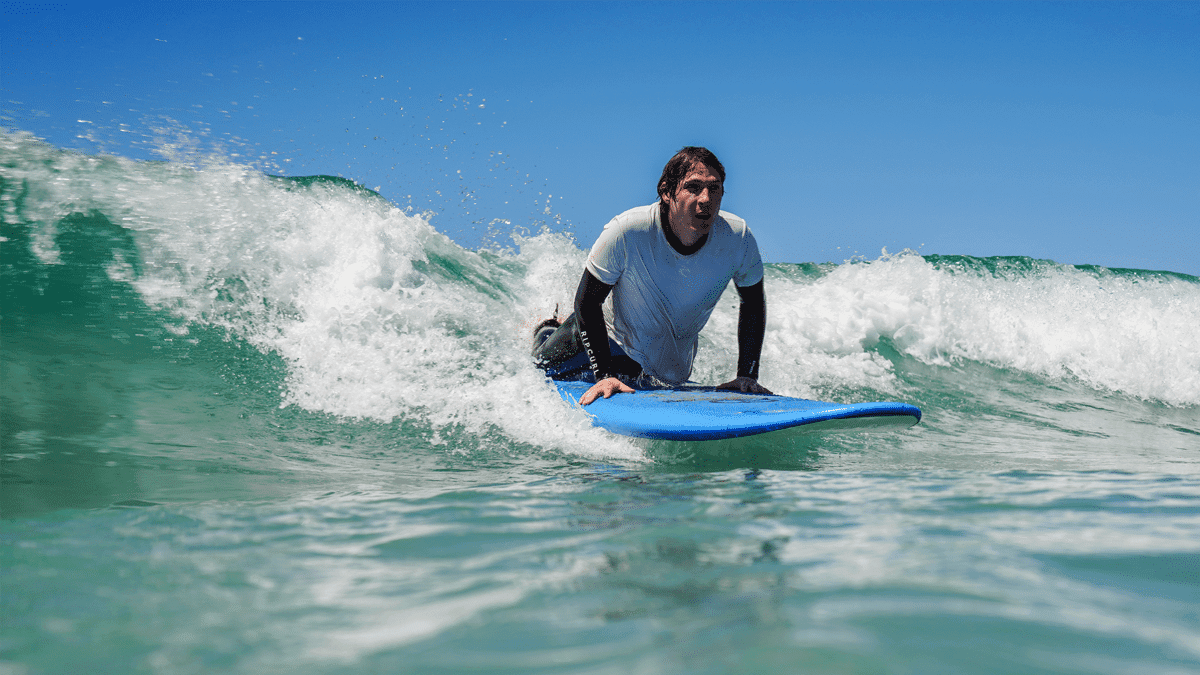
How to Do a Surf Pop-Up
Everyone remembers the first time they tried to do a pop-up.
You paddle hard, feel the wave push you… and the next second you’re on your knees on the board or getting swallowed by the whitewater.
That’s normal.
At Gecko Surf School we see this in pretty much every first lesson. The pop-up looks simple when you watch experienced surfers, but in reality it’s a mix of timing, technique, balance, and confidence.
The good news?
With the right technique and a bit of practice, you’ll start popping up much faster than you think.
In this guide, we explain:
- how to do a surf pop-up correctly
- the most common mistakes
- exercises that really help
- tips we use in Gecko Surf School lessons
What Is a Pop-Up?
The pop-up is the movement you do to go from lying on the board to your surfing stance.
It’s one of the most important fundamentals in surfing. Without a solid pop-up, it becomes hard to find your balance, control the board, and really start progressing on waves.
And here’s something important:
The goal isn’t just to stand up.
It’s to stand up with stability, control, and at the right moment.
Why Does the Pop-Up Feel So Hard at First?
Because you’re trying to put several things together at the same time:
- paddling
- feeling the wave
- keeping your balance
- getting up quickly
- placing your feet correctly
All of that in just a few seconds.
It’s completely normal for your first take-offs to feel clumsy. It’s part of the process.
In fact, many beginners make the exact same mistakes:
- looking at your feet
- using your knees
- getting up too slowly
- standing too upright
The difference comes down to practice and repetition.
How to Do a Pop-Up Step by Step
1. Paddle for Speed
Before the pop-up, you need enough speed for the wave to start pushing you.
A very common mistake is trying to stand up too early.
First:
- feel the board start gliding
- keep paddling hard
- let the wave start carrying you
Only then do you make the move.
2. Place Your Hands in the Right Position
Your hands should be next to your chest, roughly in line with your lower ribs.
Avoid grabbing the rails of the board.
Keep:
- your elbows close to your body
- your chest slightly lifted
- your eyes forward
3. Do the Movement in One Go
This is probably the most important tip.
Don’t go through your knees.
The movement should be quick and smooth:
- push your body up
- pull your feet underneath you
- land straight into your surf stance
The more you hesitate, the harder it gets.
4. Keep a Low Stance
After you stand up:
- bend your knees
- keep your weight centred
- look forward
In surfing, a low stance gives you a lot more balance.
A classic mistake is standing fully upright right away. That immediately takes away stability.
The Number 1 Beginner Mistake
Without a doubt: looking at your feet.
Your body always follows your gaze.
When you look down:
- you lose balance
- you shift your weight incorrectly
- you make the pop-up less stable
“Look where you want to go, not at the board.”
It sounds simple, but it completely changes your balance.
Should You Do the Pop-Up on Your Knees?
No.
It might feel easier at first, but it ends up slowing your progress a lot.
When you go through your knees:
- you lose speed
- you lose timing
- you build bad habits
Ideally, train the direct movement to your feet from early on.
Even if you mess up a bunch of times at the start.
Exercises That Really Help
Practise at Home
One of the best ways to improve your pop-up is to repeat the movement out of the water.
You can practise:
- on a mat
- in the sand
- at home
The more you repeat the correct movement, the more natural it becomes in the ocean.
Surf Burpees
Burpees are great because they work:
- explosiveness
- coordination
- speed
- endurance
Try doing burpees while mimicking the exact surf movement.
It helps a lot.
Work Your Core
A strong core improves:
- balance
- stability
- board control
Simple exercises like:
- planks
- mountain climbers
- Russian twists
make a big difference.
Your Board Makes a Difference Too
A big one.
At Gecko Surf School we use bigger softboards for beginners because they really help the learning process.
More volume means:
- more stability
- easier paddling
- easier pop-ups
Learning on a board that’s too small usually makes everything much harder.
How Long Does It Take to Learn?
It always depends on:
- frequency
- ocean conditions
- sports background
- confidence in the water
But most people start managing a few solid pop-ups in the first lessons.
The secret is consistency.
Surfing is repetition.
The more waves you catch, the more natural everything feels.
Final Tip from Gecko Surf School
Don’t try to do the perfect pop-up on day one.
Focus first on:
- feeling the wave
- getting your timing
- standing up with confidence
Technique improves naturally with practice and the right feedback.
And remember:
Every surfer went through this exact phase.
Even the best in the world started out by falling.
Conclusion
Learning how to do a surf pop-up is one of the most important steps in your progression as a surfer.
At first it can feel tricky, but with practice, good technique, and a few consistent sessions, you’ll feel a huge difference.
The most important thing is not to give up after the first wipeouts.
Every attempt helps you improve your timing, balance, and confidence in the water.
If you want to speed up your progress, in lessons at Gecko Surf School we’ll help you fix your stance, timing, and technique from your very first take-off — so you can truly start enjoying every wave.