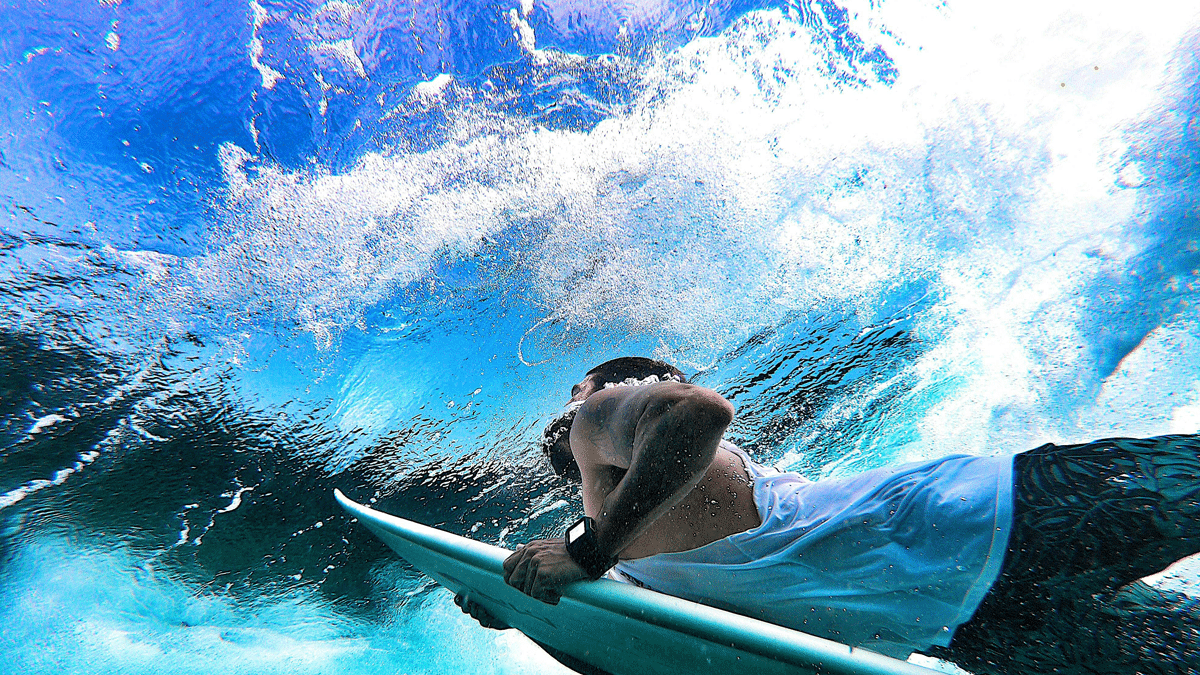
How to Do a Duck Dive in Surfing: Complete Guide to Getting Through the Break
To progress in surfing, it’s not enough to just catch waves. You need to be able to get through the break with control, efficiency, and confidence. That’s where the duck dive comes in.
The duck dive, also known by some Portuguese surfers as “bico de pato”, is one of the most important techniques for any intermediate surfer. It lets you dive under waves with your board, avoiding the impact of the whitewater and saving energy for what really matters: catching good waves.
On the beaches of Costa da Caparica, where conditions can change quickly, mastering the duck dive makes a huge difference in the water. The better you execute this technique, the easier it is to reach the line-up and the more energy you’ll have throughout the session.
At Gecko Surf School, we work on this technique regularly with surfers who want to feel more confident in more demanding conditions and progress to an intermediate or advanced level.
Key benefits of the duck dive
- Get through the break with less effort
- Save energy during the session
- Build confidence in bigger waves
- Improve board control
- Increase paddling efficiency
- Progress faster in surfing
Why it’s important to learn the duck dive in surfing
Learning to do a duck dive properly is one of those milestones that marks many surfers’ progression.
While beginners usually get past waves with more basic techniques, the duck dive lets you handle stronger conditions much more efficiently.
Without this technique, getting to the outside can become extremely tiring, especially on bigger days in Costa da Caparica or other exposed beaches in the Lisbon region.
More energy to catch waves
An efficient duck dive stops you from constantly being pushed back by the whitewater. That means less physical fatigue and more energy to paddle and catch waves throughout the session.
More confidence in the water
When you stop being afraid of the break, surfing changes completely.
Your confidence grows, you start moving better in the line-up, and you can focus more on reading the waves than on the impact of the whitewater.
How to do a duck dive in surfing step by step
1. Keep your paddle strong and steady
Speed is essential.
Efficient paddling helps the board penetrate the water and stops the wave from pushing you back. One of the most common mistakes we see in Gecko Surf School lessons is stopping paddling too early.
Keep paddling until the very last moment before the dive.
2. Position your hands correctly
Place your hands on the rails of the board, roughly at shoulder height.
This position lets you apply enough pressure to sink the nose of the board in a stable, controlled way.
3. Sink the nose of the board
Use your upper-body weight and arm strength to push the nose of the board down.
The goal is to create an angle that lets you pass through the wave in a hydrodynamic way.
4. Use your knee or foot to sink the tail
After sinking the front of the board, use your knee or foot to press down on the tail.
This helps the board dive fully and allows the wave to pass over you without dragging you back.
5. Recover your position quickly
After you get through the wave, quickly return to your paddling position.
The smoother this recovery is, the less energy you’ll spend during the session.
Most common duck dive mistakes
Not enough paddling speed
Without enough speed, the board loses its ability to penetrate and ends up being pushed back by the whitewater.
How to fix it:
- Keep your paddle strong
- Don’t hesitate
- Don’t stop paddling too early
Poor weight distribution
If your weight is too far back or too far forward, the board loses stability.
How to fix it:
- Keep your body centred
- Work on your balance
- Avoid sudden movements
Hesitating at the moment of the dive
Hesitation ruins your timing.
When you decide to duck dive, you need to fully commit to the movement.
How to improve your duck dive faster
Work on your paddling
Good paddling technique improves your duck dive immediately.
At Gecko Surf School, many surfers improve this technique dramatically just by correcting small paddling and positioning mistakes.
Train out of the water
Simple exercises can help a lot:
| Exercise | Benefit |
|---|---|
| Push-ups | More arm strength |
| Plank | Better stability |
| Burpees | Explosive power |
| TRX rows | Back and shoulder strength |
Adapt the technique to wave size
The bigger the wave:
- The deeper your dive should be
- Timing becomes more important
- You’ll need more paddling speed
On the beaches of Costa da Caparica, this adaptation makes all the difference on bigger swell days.
Duck diving on different boards
Not all boards allow you to duck dive in the same way.
Shortboards
They’re the easiest for duck diving because of their lower volume.
Funboards
They require more technique and strength to sink the board.
Softboards and longboards
In many cases, duck diving becomes difficult or impossible. In these situations, techniques like the turtle roll can be more effective.
The importance of the duck dive for intermediate surfers
The duck dive is one of the skills that usually separates beginner surfers from intermediate surfers.
When this technique starts to feel natural:
- You move better in the line-up
- You save more energy
- You gain more confidence
- You can surf in more demanding conditions
That’s why, in Gecko Surf School’s intermediate lessons, this technique is practised regularly in different sea conditions.
Conclusion
Learning to do a duck dive properly can completely transform your surfing experience.
With better technique, timing, and paddling, you’ll be able to get through the break with less effort, reach the line-up faster, and enjoy every session much more.
If you want to improve your duck dive and progress with more confidence in the ocean, Gecko Surf School offers surf lessons in Costa da Caparica tailored to your level and the day’s conditions.
FAQ
What is a duck dive in surfing?
A duck dive is a technique used to dive under waves with your board and get through the break without being pushed back by the whitewater.
What’s the best board to learn duck diving?
Shortboards are usually the easiest to learn on because of their lower volume.
Why can’t I do a duck dive properly?
The most common mistakes are not enough paddling speed, poor timing, poor weight distribution, and hesitation.
Is the duck dive important for intermediate surfers?
Yes. It’s one of the fundamental techniques for progressing in surfing and handling more demanding conditions.
Can I learn duck diving in surf lessons?
Yes. At Gecko Surf School, this technique is taught progressively according to the surfer’s level.